AI Documentation: The Complete Guide
Artificial intelligence is fundamentally transforming how organizations create, manage, and deliver knowledge. As digital ecosystems become more complex—driven by APIs, microservices, global deployments, compliance requirements, and continuous release cycles—traditional documentation practices are increasingly unsustainable.
Documentation is no longer a static artifact. It is a living system.
AI documentation refers to the comprehensive, structured, and automated process of creating, updating, governing, and optimizing technical, procedural, and operational documentation using artificial intelligence technologies. It leverages large language models (LLMs), natural language processing (NLP), machine learning (ML), retrieval-augmented generation (RAG), knowledge graphs, and DevOps automation to accelerate the documentation lifecycle while enhancing consistency, accuracy, and scalability.
This definitive guide explores AI documentation in depth—covering its architecture, technologies, workflows, enterprise strategy, governance models, ROI implications, tools, implementation roadmap, and future trajectory.
The Documentation Crisis in Modern Enterprises
Modern software organizations face unprecedented documentation pressure due to:
- Rapid CI/CD release cycles
- Distributed engineering teams
- API-first ecosystems
- Increasing regulatory oversight
- Global user bases requiring localization
- Expanding SaaS product complexity
Traditional documentation models introduce structural problems:
Version Drift
Documentation lags behind code changes.
Knowledge Silos
Critical information resides in Slack threads, tickets, and tribal memory.
High Maintenance Cost
Manual updates require repeated SME involvement.
Developer Friction
Outdated API docs reduce developer trust and adoption.
Compliance Risk
Untracked documentation changes create audit gaps.
AI documentation directly addresses these systemic inefficiencies.
What Exactly Is AI Documentation?
AI documentation is not simply “AI writing content.”
It is an intelligent documentation ecosystem that includes:
- Automated content generation from code or specs
- Intelligent summarization
- Change detection pipelines
- Context-aware content retrieval
- Conversational documentation assistants
- Auto-translation and localization
- Governance automation
- Analytics-driven optimization
It transforms documentation into a dynamic knowledge infrastructure.
Core Technologies Behind AI Documentation
Large Language Models (LLMs)
LLMs power:
- API documentation generation
- Feature explanations
- Change log summarization
- SOP drafting
- Content rewriting for different audiences
- Tone adaptation
They convert structured inputs (code, schemas, logs) into human-readable documentation.
Natural Language Processing (NLP)
NLP enables:
- Content classification
- Metadata tagging
- Semantic search indexing
- Automated topic clustering
- Content gap detection
This significantly improves discoverability.
Retrieval-Augmented Generation (RAG)
RAG grounds AI outputs in:
- Verified internal documentation
- Knowledge bases
- Policy repositories
- Code documentation
This reduces hallucinations and improves reliability.
Knowledge Graphs
Knowledge graphs map relationships between:
- APIs
- Workflows
- Compliance controls
- Personas
- Data entities
- Dependencies
This enables contextual linking and intelligent content navigation.
DevOps and CI/CD Integration
AI documentation systems connect to:
- Git repositories
- Pull requests
- Issue trackers
- Product analytics
- Release pipelines
When code changes, documentation updates can be triggered automatically.
AI Documentation Architecture
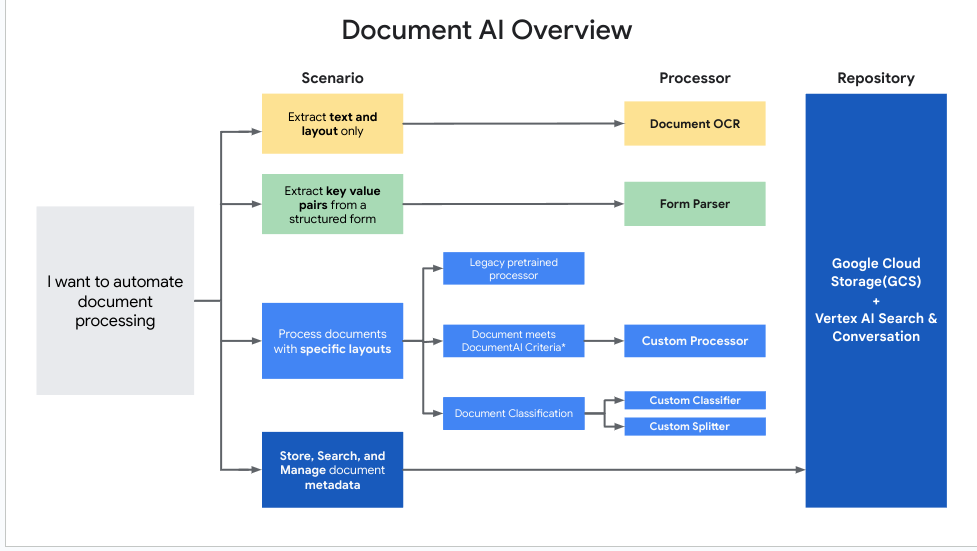
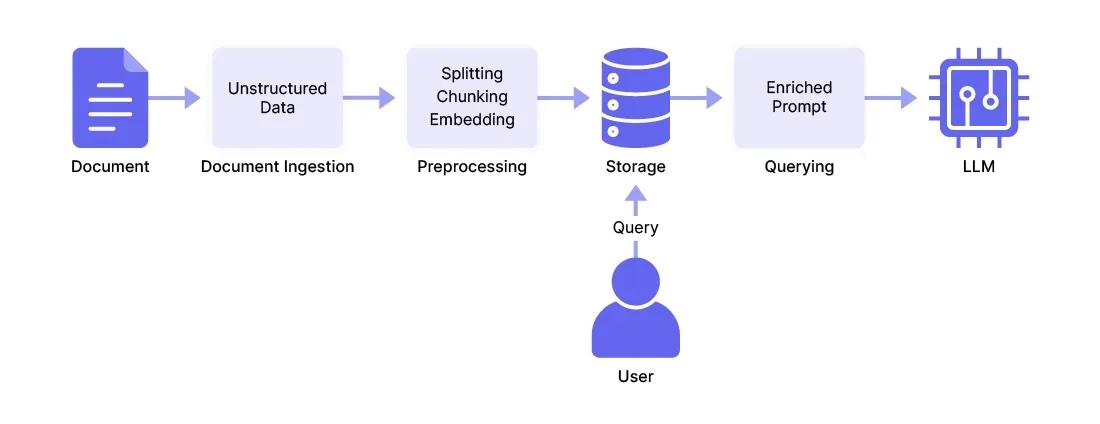
A robust AI documentation architecture includes:
Data Layer
- Source code
- OpenAPI/Swagger specs
- PRDs
- Support tickets
- UI recordings
- Product analytics
Intelligence Layer
- LLM engines
- RAG pipelines
- NLP classifiers
- Change detection models
- Translation engines
Governance Layer
- Human-in-the-loop review
- Approval workflows
- Compliance checks
- Version control
- Audit logs
Delivery Layer
- Developer portals
- Web documentation sites
- Chatbots
- In-app contextual help
- PDFs
- Multilingual outputs
AI Documentation Workflows
Developer Documentation Workflow
- Code commit pushed
- Change detection triggered
- API diff identified
- AI generates updated API reference
- SME review
- Auto-publish
Enterprise SOP Workflow
- Workflow recorded
- AI extracts steps
- AI generates structured SOP
- Compliance validation
- Approval
- Publish to knowledge portal
Regulated Industry Workflow
- Policy updated
- AI identifies impacted documents
- AI updates relevant sections
- Legal validation
- Audit log generated
Use Cases Across Industries
SaaS & Developer Platforms
- API auto-documentation
- SDK explanation
- Release note automation
Insurance & Financial Services
- Compliance documentation
- Claims workflow SOPs
- Policy documentation updates
Healthcare
- Clinical protocol documentation
- Regulatory change tracking
- Multilingual patient instructions
Telecom & Utilities
- Field technician SOPs
- Customer self-service guides
- Service outage documentation
Enterprise ROI Modeling
AI documentation drives measurable business value.
Cost Savings
Manual documentation effort:
- 40 hours per major feature release
- 10 releases per quarter
- 400 hours per quarter
AI-assisted documentation:
- 60% reduction in drafting time
Annual savings:
- 640+ hours saved
- Significant cost optimization
Support Ticket Deflection
Improved documentation reduces:
- Repetitive support queries
- Developer onboarding delays
- Escalation rates
Faster Time-to-Market
Automated documentation shortens release cycles.
AI Documentation Maturity Model
| Level | Description |
|---|---|
| Level 1 | Manual documentation |
| Level 2 | AI writing assistance |
| Level 3 | Automated generation |
| Level 4 | Integrated change detection |
| Level 5 | Autonomous documentation agents |
Most enterprises operate between Levels 1–2.
Governance & Risk Framework in AI Documentation
AI documentation systems introduce automation, intelligence, and scalability — but they also introduce new categories of risk. Without structured governance, AI-generated documentation can create compliance gaps, propagate inaccuracies, introduce bias, or expose sensitive information.
In enterprise environments — particularly in regulated sectors such as finance, insurance, healthcare, and telecom — governance is not optional. It is foundational.
A robust AI documentation governance framework must address:
- Accuracy validation
- Traceability
- Version integrity
- Security controls
- Ethical safeguards
- Accountability mechanisms
Below is a detailed breakdown of the critical pillars of AI documentation governance.
Human-in-the-Loop Validation
AI accelerates drafting — but it must not replace expert oversight.
Large language models generate content probabilistically. Even when highly accurate, they may:
- Introduce subtle technical inaccuracies
- Misinterpret architectural dependencies
- Oversimplify compliance language
- Omit edge-case conditions
- Generate plausible but incorrect examples
This is particularly dangerous in:
- API documentation
- Financial compliance instructions
- Clinical workflow documentation
- Safety or regulatory procedures
Why Human Validation Is Non-Negotiable
Subject Matter Experts (SMEs) ensure:
- Technical correctness
- Architectural alignment
- Terminology consistency
- Domain nuance
- Regulatory adherence
AI can draft the structure, but SMEs validate the substance.
Recommended Human-in-the-Loop Model
A mature governance workflow includes:
- AI Draft Generation
The system generates initial documentation based on source inputs. - Automated Rule Checks
Pre-validation scans check formatting, policy references, terminology alignment. - SME Review Stage
Domain experts validate technical accuracy and completeness. - Editorial Review Stage
Documentation specialists ensure clarity, tone, structure, and audience alignment. - Approval & Publish Workflow
Finalized content is approved through role-based governance.
This structured validation pipeline preserves speed while maintaining accountability.
Version Control Integration
One of the most common documentation failures is version drift — when documentation does not reflect the latest system state.
AI documentation systems must be tightly integrated with source-of-truth repositories.
Why Version Traceability Matters
Without version linkage:
- API documentation may reference deprecated endpoints
- Feature guides may describe outdated UI flows
- Compliance documentation may reference obsolete regulations
- Internal SOPs may misalign with operational reality
In regulated environments, this can create audit risk.
Best Practices for Version Integration
Git-Based Synchronization
Documentation repositories should:
- Mirror code repositories
- Be stored in version-controlled environments (e.g., Git-based systems)
- Include commit references in documentation updates
Each documentation change should map to:
- A code commit
- A feature release
- A change request
- A policy update
Automated Change Detection
AI systems should:
- Detect diffs in code or schemas
- Identify impacted documentation sections
- Trigger update workflows automatically
This reduces reactive manual corrections.
Documentation as Code (Docs-as-Code)
Adopting a Docs-as-Code model ensures:
- Pull request workflows
- Peer reviews
- Branch management
- Rollback capabilities
This aligns documentation governance with DevOps discipline.
Data Security Controls
AI documentation pipelines often ingest sensitive enterprise data:
- Source code
- Internal architecture diagrams
- Customer information
- Regulatory policies
- Proprietary algorithms
Improper AI deployment can introduce data leakage risk.
Security Risks to Address
- Transmission of proprietary data to external LLM APIs
- Unauthorized access to documentation drafts
- Prompt injection vulnerabilities
- Model training exposure risks
- Data retention uncertainties
Secure AI Deployment Models
Private LLM Deployments
Enterprises handling sensitive information should consider:
- On-premise LLM hosting
- Private cloud deployments
- Encrypted API gateways
- Strict access control layers
This ensures sensitive content never leaves controlled environments.
Role-Based Access Controls (RBAC)
AI documentation systems must enforce:
- Author permissions
- Reviewer permissions
- Publish permissions
- Read-only access tiers
Sensitive documentation (e.g., regulatory controls) must have restricted editing privileges.
Data Minimization Policies
AI systems should ingest only necessary contextual data — not entire repositories blindly.
Controlled retrieval mechanisms (e.g., RAG pipelines) ensure:
- Only verified and relevant documents are used for generation
- Sensitive data is excluded where unnecessary
Audit Logging
Every AI-generated or AI-edited document should maintain:
- Timestamp
- Author or AI agent identifier
- Prompt reference
- Reviewer sign-off
This ensures forensic traceability.
Bias Monitoring & Ethical Oversight
AI models inherit biases from training data. Without monitoring, documentation can unintentionally:
- Reinforce stereotypes
- Use exclusionary language
- Introduce culturally insensitive phrasing
- Provide imbalanced regulatory interpretations
In enterprise contexts, biased documentation can damage brand trust and expose legal liability.
Types of Bias in Documentation
- Linguistic bias
- Cultural bias
- Gendered language bias
- Accessibility oversight
- Domain-specific interpretive bias
Governance Strategies for Bias Mitigation
Structured Prompt Engineering
Use standardized prompts that:
- Enforce neutral language
- Follow inclusive style guidelines
- Avoid subjective phrasing
AI Output Auditing
Establish periodic audits of AI-generated documentation to:
- Evaluate neutrality
- Assess tone
- Ensure inclusivity
- Validate compliance language
Diversity Review Panels
For global organizations, include reviewers from:
- Different geographies
- Diverse backgrounds
- Legal and compliance teams
This reduces cultural blind spots.
Accessibility Compliance
AI documentation systems should support:
- WCAG accessibility standards
- Screen-reader compatible formatting
- Structured heading hierarchies
- Clear language principles
Ethical governance strengthens credibility.
Accountability & Documentation Ownership
AI systems can obscure responsibility if governance is unclear.
Every documentation asset must have:
- A defined owner
- A validation authority
- A publication approver
- A compliance reviewer (if applicable)
Even when AI drafts 80% of the content, accountability remains human.
Clear ownership ensures:
- Faster update cycles
- Fewer governance disputes
- Clear audit accountability
Risk Matrix for AI Documentation
| Risk Category | Description | Mitigation Strategy |
|---|---|---|
| Hallucination | AI fabricates incorrect info | RAG + SME validation |
| Version Drift | Docs misaligned with code | Git integration + change detection |
| Data Leakage | Sensitive data exposed | Private LLM + RBAC |
| Bias | Non-neutral content | Auditing + inclusive prompts |
| Over-Automation | Blind trust in AI output | Human-in-the-loop governance |
| Compliance Failure | Regulatory inaccuracies | Legal review stage |
Governance Maturity Levels
| Level | Governance Capability |
|---|---|
| Level 1 | AI drafts without review |
| Level 2 | Manual SME validation |
| Level 3 | Integrated version control |
| Level 4 | Automated change detection + audit logs |
| Level 5 | Enterprise-grade AI governance with compliance automation |
Mature organizations aim for Levels 4–5.
Strategic Conclusion: Governance as Competitive Advantage
AI documentation without governance is operational risk.
AI documentation with governance is strategic leverage.
When properly governed, AI documentation:
- Improves compliance posture
- Enhances audit readiness
- Reduces operational exposure
- Strengthens brand credibility
- Builds long-term trust in automation
Enterprises that embed governance into AI documentation workflows will not only scale faster — they will scale responsibly.
Comparative Overview of Leading Platforms
| Platform | AI Capabilities | Best For | Considerations |
|---|---|---|---|
| GitBook | AI search, summarization | Developer docs | Limited automation |
| Document360 | AI writing + analytics | Enterprise KB | Cost factor |
| Docusaurus | AI plugin ecosystem | Custom developer portals | Engineering required |
| Notion | AI content drafting | Internal docs | Not API-focused |
| Confluence | Atlassian Intelligence | Enterprise collaboration | General-purpose |
AI Documentation vs Traditional Documentation
| Dimension | Traditional | AI-Driven |
|---|---|---|
| Speed | Manual | Automated |
| Scalability | Limited | High |
| Accuracy | Human dependent | AI + Human |
| Updates | Reactive | Trigger-based |
| Personalization | Static | Dynamic |
Emerging Trends
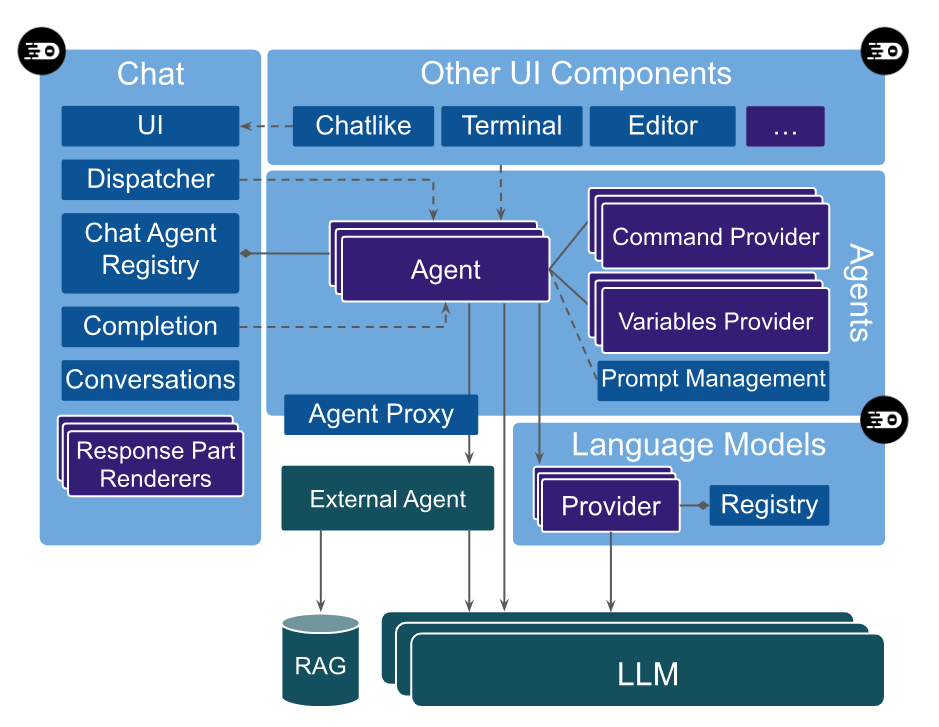
Autonomous Documentation Agents
AI systems that monitor repositories and proactively update documentation.
IDE-Embedded Documentation Copilots
Developers generate docs directly inside IDE environments.
Context-Aware In-App Help
Documentation appears based on user behavior signals.
Enterprise Knowledge Graph Ecosystems
Interconnected content mapping across departments.
Implementation Roadmap (Step-by-Step)
Step 1: Documentation Audit
Identify high-impact areas.
Step 2: Pilot AI Writing Assistance
Start with AI drafting tools.
Step 3: Integrate with CI/CD
Enable change-triggered documentation.
Step 4: Introduce RAG Systems
Ground AI outputs in verified knowledge.
Step 5: Scale Across Enterprise
Expand to multilingual and compliance workflows.
KPIs for Measuring Success
Track:
- Documentation update latency
- Support ticket reduction
- Developer satisfaction scores
- Knowledge search success rate
- Time-to-publish metrics
- Localization turnaround time
Frequently Asked Questions (SEO Section)
Is AI documentation reliable?
Yes, when implemented with RAG pipelines and human validation.
Can AI fully replace technical writers?
No. AI accelerates drafting but requires SME oversight.
Is AI documentation secure?
Private LLM deployments mitigate data risks.
What industries benefit most?
SaaS, finance, healthcare, insurance, telecom, and any compliance-heavy sector.
The Strategic Imperative
AI documentation is not a productivity hack. It is a structural shift in knowledge management.
Organizations that adopt intelligent documentation systems gain:
- Faster innovation cycles
- Stronger compliance posture
- Better developer adoption
- Reduced operational inefficiencies
- Scalable global documentation
The Future Outlook
Over the next five years:
- Enterprise-trained private LLMs will dominate documentation workflows.
- Documentation-aware coding assistants will reduce doc-code mismatch.
- Autonomous AI agents will manage documentation pipelines end-to-end.
- Knowledge graph-driven ecosystems will unify enterprise knowledge.
Documentation will become predictive, adaptive, and deeply embedded in product lifecycles.
Final Conclusion
AI documentation represents the convergence of artificial intelligence, knowledge management, DevOps, and enterprise governance.
It transforms documentation from a reactive afterthought into a strategic capability.
The winning formula is balanced:
AI accelerates.
Humans validate.
Governance safeguards.
Architecture scales.
In an economy where information velocity defines competitiveness, intelligent documentation is foundational.